When I started planning my 2020 race season, I was interested in adding an international race somewhere I had never raced before.  I enjoy racing internationally to experience new trails and cultures all over the world, so I started looking around for options.  My wife (Karen) and I have been fortunate to travel quite a bit internationally, and to this day, my favorite country on earth is New Zealand.  We had been there twice before, and I was always excited about the possibility of returning for a third time.  So, when I received an elite invite to the Tarawera Ultramarathons, it was a no-brainer to accept and I promptly signed up for the 100-Miler!

Ever since I became a sponsored ultrarunner in 2016, my forte in the sport has been the 100-miler.  I love everything about that distance and while I thoroughly enjoy running races of any length, this is the one that fills my soul and fuels my fire.  I quickly found out that New Zealanders refer to this distance as “The Miler,” since the 100k is known as the “Hundred” (metric system and all).  I found that especially funny because hearing that put me right back in sixth grade gym class, getting mentally ready to run four laps around a track!

The thing that made this race different from previous 100-milers was that it was so early in the season.  Prior to this year, the earliest I’ve ever run a 100-miler was when I ran Western States in June of 2018.  So, this race fell a full four-plus months earlier in the season than any prior hundo I’ve run, which dictated a different approach to the preparation.  Coming off a long 2019 season that started with some injury issues, I knew it was especially important to take some proper rest and recovery time at the end of the year.  That meant my build to Tarawera would be really light, relative to where I would like to be in the middle of the season.  Knowing that, I took a much different mental mindset heading into the race: I felt healthy, I was stoked to be running in New Zealand, and I accepted that I would be undertrained (but motivated) at the start line!

Race day arrived and the weather, although warm, was not as hot as the prior days and what was initially projected.  I went for a short warm-up run prior to the race start at 4am, and the body felt good, but I didn’t feel the energetic bounce in my step I was hoping for.  Nonetheless, I headed to the start line feeling fired up!  After an amazing cultural dance performance by the Māori people, the Race Director, Tim Day, set us off on our journey.  From the jump, the eventual winner of the race (Vlad) set off at a blistering pace while I settled in with the second group of about five other runners.  We spent the first miles just chatting and getting to know each other, running through light rain in the dark on the jungle-esque trails of Rotorua, New Zealand.  When we hit the first aid station less than ten miles in, I was already pretty wet from the humidity and rain, so I reorganized my kit and fueled up.  Thankfully, Karen was there to crew me the entire way, because the day would not have been a success without her!

Karen crewing me while I enjoy sitting in Barry’s chair!

Since I took an extra minute at the first aid station, the group of guys I was running with forged on ahead, and I spent the next 25-30 miles running solo.  I felt good, but my legs just felt generally fatigued, which I presumed was because of the lack of volume in my build up to the race.  So, I was grateful to be running my own race at that point and focusing on nutrition and hydration.  I always like to tell my athletes to “focus on what’s within your control,” during a race, and at that point, I couldn’t control how my legs felt but I could certainly keep up with fueling!  Around the 50k mark, after a beautiful water crossing in a boat, I came into an aid station a couple minutes behind Zac and Carl, two of the guys I ran the first ten miles with earlier.  I kept them within my line of sight until the next aid station, when I met up with Karen one more time before we had a big gap of about 60k until the next crew accessible aid station.  I loaded up on everything I needed and started to chase them again.  Around the 40-mile mark, I synced back up with Zac and we settled into a nice pace together.  At that time, I was still feeling pretty flat and Zac was having some stomach issues, so we both were running strong, but at sub-optimal pace.  Around the 50-mile mark, we were caught by the eventual female winner, Ailsa Macdonald, one of the best female ultrarunners in the world.  She was running very strong and she took off ahead of us, while we maintained the effort that was working for us.

That continued for another ten miles or so, and then a little before the 100k mark, I was running up a hill while Zac hiked, so I told him I would meet him on the other side.  When I crested the hill, things started feeling easier, so I slowly started pushing a little harder.  From that point on, everything started to click.  That’s the funny thing about a 100-miler: sometimes you feel better at Mile 62 than you do at the start!  I rode that high for most of the remainder of the race, passing Carl at the next aid station and then finally catching Brendan (also from the original group I started with) around Mile 70, which put me into 4th overall and 3rd male.  I would venture to guess that I ran that final 50k as fast as anyone else in the race, moving really well all the way until the finish at just over 18 hours.

Finish line hug with RD Tim Day!

This was a sneaky hard course, without a lot of vert but with plenty of sections that were not as runnable as the course profile made it seem.  With winding, narrow single-track, filled with roots and rocks, it was often hard to maintain a fast rhythm.  But what the course took away in speed, it gave back tenfold in beauty!  And I’ll take that trade off any day.  This was the first 100-miler that Karen ever crewed for me solo, and on top of that, she was doing it in another country!  Without our usual team (namely, my friend Josh who crews most of my races) to help her, she shouldered the burden of taking care of me all day, and I couldn’t be more grateful for that.  Special shout-out to Barry (Ailsa’s husband) for letting me borrow their chair at the aid station after the boat crossing.  I told Barry “Sorry I’m going to get this chair so wet from my sweat,” to which he replied, “it’s okay…my wife was going to do that anyway!”  In the end, I finished with my seventh 100-mile podium at a race where it took me almost 100k to feel like I had finally hit my stride.  But if there’s one thing I know about 100-mile races, it’s that the only thing you can expect…is the unexpected!
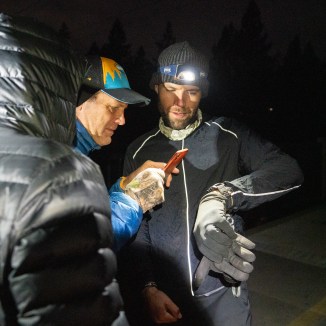
On Friday, October 11th at 5:15am, I set out just a mile from my home in Tahoe City to attempt to break the Fastest Known Time for the Tahoe Rim Trail.  I was running from Tahoe City clockwise all the way around Lake Tahoe, hoping to finish in under 38 hours and 32 minutes and break the record set in 2009 by Kilian Jornet.  Ultimately, however, I ended up finishing the 172-mile trail in 45 hours, 36 minutes and 36 seconds, good for the second-fastest time ever recorded around the trail.  The trail in 2019 is a full seven miles longer than it used to be (as it was originally created at 165 miles), so I believe I set the fastest time on the most updated version of the trail!  When I set out to run this trail, I knew that GPS watch battery was going to potentially be an issue, since I didn’t have a watch remotely capable of recording for that long.  Enter the Coros Vertix.

This is, without question, the best watch I’ve ever owned.  Here are the primary reasons why: user interface and watch setup; ease of uploading and connecting to third-party apps; and of course, battery-life.  First, the user interface and setup.  When the watch arrived in the box, it had very few settings options to navigate.  It wasn’t until you download the app and sync your watch to it that the real fun begins.  At that time, through the “Custom Interface” of the app, you can set up multiple screens on the watch to utilize whatever data you want to see!  For me, I chose a six-slot design for the primary screen.  The six items I chose were Distance, Lap Pace (pace for that individual mile), Pace (current speed at any moment), Total Ascent, Elevation and Time.  And that was just for the first screen!  You can spin the dial on the side of the watch to switch between other screens, all of which are customizable.  Pretty rad.  Second, the ease of uploading and connectivity to other apps.  I am a big fan of the fact that anytime you record an activity on the Coros Vertix, it uploads to the app super quickly.  So, as an avid user of Strava, it’s nice to know that I will have my activities posted in no time.  Lastly, the battery life.  What more is there to say?  The Vertix is good for up to 60 hours in full GPS mode!  Insane.  When I ran around the Tahoe Rim Trail, I was out there for over 45 hours, and still had close to 10% battery life when I finished.  I’m thrilled to know that every 100-miler I run in the future will be more than covered by the battery life, and I will no longer need to worry about swapping out watches during a race!

A few other positives to note.  The watch is quite quick to pick-up GPS outdoors, something that has occasionally caused me frustration in the past.  It also has a wrist heart-rate sensor, something I’ve never had before in a watch.  I don’t worry too much about HR data personally, but it’s still a nice feature for sure.  I also like that there are so many activity functions, ranging from “Run” and “Bike” all the way to “Gym Cardio” and “Mtn Climb.”  While I have yet to use many of those functions, I’m stoked to have them!

Lastly, I only have two comments in the way of improvement.  First, when you set up the interface of the watch, you get to choose a “Watch Face Setting.”  I found one that I really like, but I do wish there were some more options to choose from in case I want to mix it up more often.  Or, perhaps there could be a way for users to customize that outside of the pre-chosen options.  The other thing is that the back of my wrist will sometimes touch the dial and send me to a different screen.  It happens infrequently, but it does occasionally happen.  In that case, I just have to turn the dial back to the home screen where I want to be.

When it comes right down it, I LOVE this watch.  I’m a relatively simple user of GPS watches, so battery life, easy interface, and simple navigation of the tools are my top priorities.  With the Coros Vertix, you get all of that and so much more!

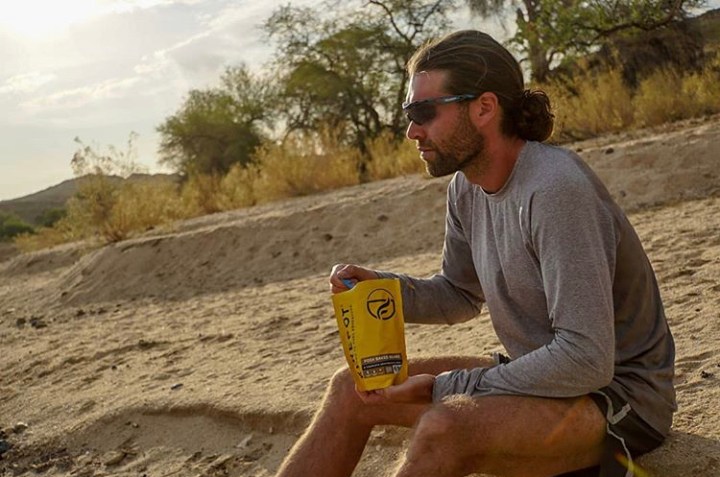
When you’re out running miles upon miles in the middle of a really hot desert, you need to get your nutrition dialed or risk running on empty.  So, when I left to head out to the Namib Desert for Beyond the Ultimate’s Desert Ultra, I was highly focused on getting my nutrition right.  I was equally concerned for this particular race because I gambled on a product I had never used before.  Thankfully, that gamble paid off in a big way.

When determining needs for stage race nutrition, I feel from my experience that there are three main things to consider in your food choices: nutritional profile, caloric density plus weight, and variety. First, I look at the nutritional value each meal provides for me.  Am I getting enough carbs?  Protein?  Salt and sugar?  The runners in a stage race are typically running for five or six days and over 150 miles, so eating “empty” calories will eventually result in an energy deficiency.  The runners need to do what they can to eat as well as possible, without having a kitchen and a full refrigerator at their disposal.  Thankfully, Firepot does things a little differently than most on-the-go fuel sources.  Instead of freeze-dried food, their meals are dehydrated to maintain better nutritional integrity than if they had been cooked and frozen.

img_1004

Secondly, caloric density is incredibly important to keep up with all the calories you’re burning in the hot desert.  You need to pack as many calories as you can into your bag, without the weight dragging you down into the sand!  Firepot offers extra-large meal servings ranging between 695-830 calories each, of which I would consume three per day.  The combination of those meals still resulted in weight loss due to the extreme heat and so much energy expenditure, but it kept my energy levels high from the start line all the way to the finish!

Lastly, it doesn’t take a long time in the desert to wish you were eating and drinking the things you can’t have until you finish, so it’s important to have a variety of choices to keep your mind off everything you don’t have!  As a pescatarian, I was thrilled that Firepot offered five different vegan options for me to eat throughout the week.  Being able to rotate five different flavor options throughout the race kept me from getting tired of eating the same thing repeatedly.  It didn’t, however, keep me from daydreaming about cold Coke and beer!  My personal favorite meal was the “Vegan Orzo Bolognese,” which was not only delicious, but also one of the highest calorie options…win-win!

At the end of a week filled with elephant and giraffe sightings, blistering temperatures, and new lifelong friends, I came away with a first-place finish and a new course record.  There were so many highs and lows throughout the week, none of which were fuel-related.  As a professional ultrarunner and coach, I know that there are many viable options for good nutrition during a race.  However, it’s clear to me that my strength and health throughout the week were largely in part due to the tasty, nutritional Firepot meals in my pack.  The next time I lace up the shoes for a stage race, Firepot will fuel me once again!


What does 130 degrees feel like?  I think it’s best described as the type of heat that you feel everywhere.  It doesn’t matter if you’re under a shaded tent…you can’t escape it.  It’s rough of course, but to be honest, you don’t come to the middle of the desert searching for ideal conditions.  Deep down, whether we knew it or not, all the competitors came to the middle of the Namib Desert for an epic, HOT experience.  And that’s exactly what we got!

Even though I had run a stage race in the Gobi Desert just three years ago, I forgot about the little nuances of the week and the “routine” of it all.  Those are the things that make stage racing so special.  It’s the seemingly endless hours laying underneath a canopy, with your legs up on a chair, chatting with your fellow competitors, the race crew and the incredible team of medics.  It’s drinking room temperature water all week, wishing for nothing more than a cold can of Coke or an ice-cold beer.  It’s eating expedition food for every meal and dreaming about what you will eat when you are no longer stranded (by choice) in the middle of a barren desert.  And it’s the recognition that there is virtually nothing you can do to get clean until the week is over.  You simply must succumb to the relentless sand all over your body and your kit!

45416816854_d79c117233_o

And then, of course, there is the EPIC.  Chasing after wild horses while being dwarfed by the Brandberg Mountain, the largest peak in Namibia.  Watching as a herd of elephants walks right through the campsite, grazing on the trees as they pass by.  Seeing giraffes and rhinos running in the distance and feeling so small in the middle of such a vast place.  Running 160 miles over the course of 5 stages, trying not to spontaneously combust from the 130-degree heat.  And most importantly, forging lifelong bonds with the other crazies who willingly decided to join you on this endeavor.  There is an unspoken bond between all the athletes toeing the line at a self-supported stage race, and when you experience such highs and lows together as a group, you come out the other side with some of the best friends you’ll ever have in your life.

Unplugged and without access to the typical pleasantries of everyday life, seclusion in one of the oldest and hottest deserts in the world has given me so much amazing perspective.  If you have an opportunity to experience a self-supported stage race, you must.  It will change you for the better.  For me, I once again had one of the raddest and most memorable weeks of my life.  The friendships and the memories made in that desert are permanent.  The win and the course record were just the cherry on top!

45416823094_60b2954776_o