
When I started planning my 2020 race season, I was interested in adding an international race somewhere I had never raced before. I enjoy racing internationally to experience new trails and cultures all over the world, so I started looking around for options. My wife (Karen) and I have been fortunate to travel quite a bit internationally, and to this day, my favorite country on earth is New Zealand. We had been there twice before, and I was always excited about the possibility of returning for a third time. So, when I received an elite invite to the Tarawera Ultramarathons, it was a no-brainer to accept and I promptly signed up for the 100-Miler!
Ever since I became a sponsored ultrarunner in 2016, my forte in the sport has been the 100-miler. I love everything about that distance and while I thoroughly enjoy running races of any length, this is the one that fills my soul and fuels my fire. I quickly found out that New Zealanders refer to this distance as “The Miler,” since the 100k is known as the “Hundred” (metric system and all). I found that especially funny because hearing that put me right back in sixth grade gym class, getting mentally ready to run four laps around a track!
The thing that made this race different from previous 100-milers was that it was so early in the season. Prior to this year, the earliest I’ve ever run a 100-miler was when I ran Western States in June of 2018. So, this race fell a full four-plus months earlier in the season than any prior hundo I’ve run, which dictated a different approach to the preparation. Coming off a long 2019 season that started with some injury issues, I knew it was especially important to take some proper rest and recovery time at the end of the year. That meant my build to Tarawera would be really light, relative to where I would like to be in the middle of the season. Knowing that, I took a much different mental mindset heading into the race: I felt healthy, I was stoked to be running in New Zealand, and I accepted that I would be undertrained (but motivated) at the start line!
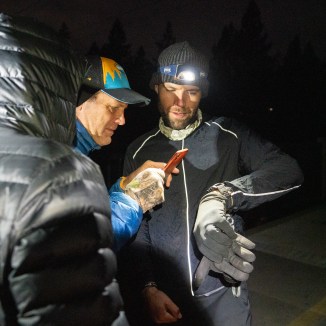
Race day arrived and the weather, although warm, was not as hot as the prior days and what was initially projected. I went for a short warm-up run prior to the race start at 4am, and the body felt good, but I didn’t feel the energetic bounce in my step I was hoping for. Nonetheless, I headed to the start line feeling fired up! After an amazing cultural dance performance by the Māori people, the Race Director, Tim Day, set us off on our journey. From the jump, the eventual winner of the race (Vlad) set off at a blistering pace while I settled in with the second group of about five other runners. We spent the first miles just chatting and getting to know each other, running through light rain in the dark on the jungle-esque trails of Rotorua, New Zealand. When we hit the first aid station less than ten miles in, I was already pretty wet from the humidity and rain, so I reorganized my kit and fueled up. Thankfully, Karen was there to crew me the entire way, because the day would not have been a success without her!

Since I took an extra minute at the first aid station, the group of guys I was running with forged on ahead, and I spent the next 25-30 miles running solo. I felt good, but my legs just felt generally fatigued, which I presumed was because of the lack of volume in my build up to the race. So, I was grateful to be running my own race at that point and focusing on nutrition and hydration. I always like to tell my athletes to “focus on what’s within your control,” during a race, and at that point, I couldn’t control how my legs felt but I could certainly keep up with fueling! Around the 50k mark, after a beautiful water crossing in a boat, I came into an aid station a couple minutes behind Zac and Carl, two of the guys I ran the first ten miles with earlier. I kept them within my line of sight until the next aid station, when I met up with Karen one more time before we had a big gap of about 60k until the next crew accessible aid station. I loaded up on everything I needed and started to chase them again. Around the 40-mile mark, I synced back up with Zac and we settled into a nice pace together. At that time, I was still feeling pretty flat and Zac was having some stomach issues, so we both were running strong, but at sub-optimal pace. Around the 50-mile mark, we were caught by the eventual female winner, Ailsa Macdonald, one of the best female ultrarunners in the world. She was running very strong and she took off ahead of us, while we maintained the effort that was working for us.
That continued for another ten miles or so, and then a little before the 100k mark, I was running up a hill while Zac hiked, so I told him I would meet him on the other side. When I crested the hill, things started feeling easier, so I slowly started pushing a little harder. From that point on, everything started to click. That’s the funny thing about a 100-miler: sometimes you feel better at Mile 62 than you do at the start! I rode that high for most of the remainder of the race, passing Carl at the next aid station and then finally catching Brendan (also from the original group I started with) around Mile 70, which put me into 4th overall and 3rd male. I would venture to guess that I ran that final 50k as fast as anyone else in the race, moving really well all the way until the finish at just over 18 hours.

This was a sneaky hard course, without a lot of vert but with plenty of sections that were not as runnable as the course profile made it seem. With winding, narrow single-track, filled with roots and rocks, it was often hard to maintain a fast rhythm. But what the course took away in speed, it gave back tenfold in beauty! And I’ll take that trade off any day. This was the first 100-miler that Karen ever crewed for me solo, and on top of that, she was doing it in another country! Without our usual team (namely, my friend Josh who crews most of my races) to help her, she shouldered the burden of taking care of me all day, and I couldn’t be more grateful for that. Special shout-out to Barry (Ailsa’s husband) for letting me borrow their chair at the aid station after the boat crossing. I told Barry “Sorry I’m going to get this chair so wet from my sweat,” to which he replied, “it’s okay…my wife was going to do that anyway!” In the end, I finished with my seventh 100-mile podium at a race where it took me almost 100k to feel like I had finally hit my stride. But if there’s one thing I know about 100-mile races, it’s that the only thing you can expect…is the unexpected!
 Adam Kimble